Aquarius Season Bonus Materials
Scroll through to access all of the Aquarius section bonus materials.
Aquarius Season Playlist
Dry Heat/Nice Town - Cheekface // Alien She - Bikini Kill // Presumably Dead Arm - Sidney Gish // The Guillotine - The Coup // Borderline - Tame Impala // Virtual Insanity - Jamiroquai // Close Your Eyes (and Count to Fuck) - Run the Jewels // Space Girl - Frances Forever // Space Song - Beach House // Los Ageless - St. Vincent // I’m Writing a Novel - Father John Misty // What’s Up - 4 Non Blondes // Off You - The Breeders
Meet the Court
This Aquarius knew how to stand her ground. Meet the Queen of Swords (IRL).
Meet the Queen of Swords (IRL) - Rosa Parks
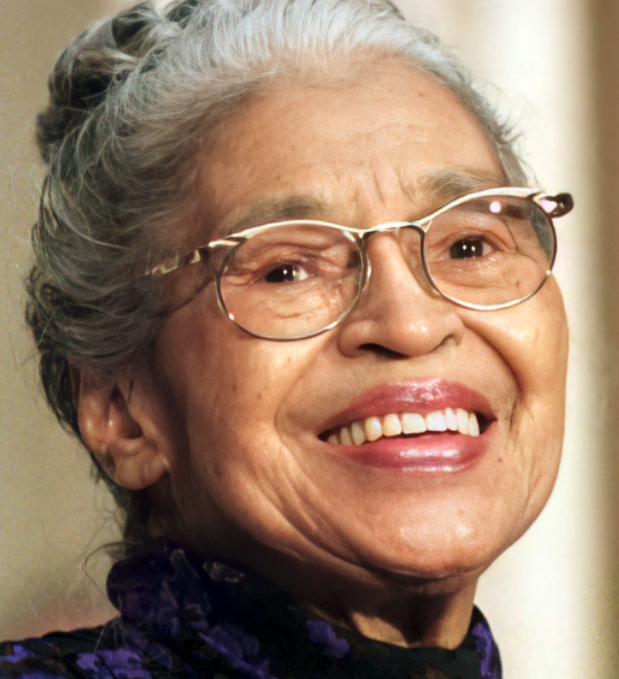
Civil rights legend Rosa Parks was born on February 4, 1913, in Tuskegee, Alabama. She was a Capricorn Rising with a 1st House Aquarius stellium, including her Sun, Mercury, and Uranus, plus a Scorpio Midheaven and a 12th House Capricorn Moon. She's the perfect air/water blend to represent the Queen of Swords IRL.
Parks' parents separated when she was a toddler, and her mother moved the family to Pine Level, Alabama, to be closer to her grandparents. Her grandparents had themselves been formerly enslaved and became vocal advocates for racial equality, and growing up in the segregated South, Rosa watched her elder relatives hold their ground throughout her childhood. She publicly recalled one moment when she watched her grandfather stand on the porch with a shotgun while the KKK marched down the street.
Parks attended a segregated school in Pine Level that routinely lacked adequate supplies. Black students were forced to walk to school while white students had access to a bus. Parks left school in the 11th grade to care for sick relatives and never returned, instead going to work in a shirt factory — though she did eventually earn her GED.
At 19, she married Raymond Parks in 1932. He was a barber and an active member of the NAACP, and Rosa joined the organization herself in 1943. The couple never had children but dedicated their lives to the NAACP's work; Rosa served as youth chapter leader and held secretary roles under the organization's president.
On December 1, 1955, Parks had just finished a long day working as a seamstress in a department store. Riding the bus home, she took a seat in the first few rows designated for Black passengers. As the bus filled up, the driver noticed white passengers standing in the aisle, stopped the bus, moved the sign separating Black and white passengers, and demanded that four Black passengers, including Parks, give up their seats — or have the police called to remove them. Three complied. Parks did not. When the driver demanded, "Why don't you stand up?" she replied, "I don't think I should have to stand up." She kept her cool and held her ground, and the driver called the police and had her arrested.
This legendary event kicked off the Montgomery Bus Boycott. The president of the NAACP began planning the demonstration the very night Parks was arrested. Starting December 5, 1955 — the day of her scheduled trial — people were encouraged not to use the bus system. The effort was a massive success, lasting more than a year. Parks was found guilty and fined $14 (around $150 today, adjusted for inflation), but the boycott itself was the real win. With dozens of buses sitting idle across Montgomery, transit companies took a serious financial hit. Segregationists retaliated — churches and homes were burned, and the NAACP president's house was bombed. Ultimately, the boycott proved pivotal in overturning Jim Crow laws in 1956.
After the boycott, Parks became a well-known civil rights symbol, but she was also facing real financial struggles — both she and her husband had lost their jobs over the incident. The couple moved to Detroit for a fresh start, where she worked as a secretary in a congressional office and became heavily involved with Planned Parenthood. In the early 2000s, Parks was diagnosed with dementia, and on October 24, 2005, she died in her Detroit apartment.
Parks received many honors during her lifetime, including the Spingarn Medal — the NAACP's highest honor — and the prestigious Martin Luther King Jr. Award. She was even named to TIME magazine's "20 Most Influential People of the 20th Century" list in 1999.
Parks perfectly exhibits the Queen of Swords archetype, showing us the importance of level-headedness and boundaries. Although she has passed, her civil rights legacy lives on.
We already know that Aquarius is focused on community care, and when the sun transits through the water-bearer's territory, we often feel called to contribute to collective well-being. So, there's no better time than the present to talk about mutual aid. Mutual aid is a simple concept. It's a network of people and resources who work together to meet the needs of everyone within a community. It isn't a new idea, but with the current state of the world, the concept has re-surfaced in mainstream culture.
The term was coined by an anarchist named Peter Kropotkin. He spent time in the Siberian wilderness observing competition in the natural world. Well, at least that's what he thought he would witness. Instead, he found that animals were uniting against shared struggles. He penned an essay in 1902 citing, "In the long run, the practice of solidarity proves much more advantageous to the species than the development of individuals endowed with predatory inclinations."
We've seen mutual aid throughout history in groups such as The Black Panther Party and the numerous fraternal societies tied to the labor movement in the United States. These networks tend to surge in popularity when times are lean and social systems aren't working to protect the population. So, it is no surprise that these movements have been on the rise since 2019.
-
Mutual aid is not charity. This is one of the biggest misconceptions about community organizing work. Mutual aid is about mutual sharing and support.
Aid can be financial or non-financial. While material resources are a need within mutual aid structures, support can also be service/time-based etc. all contributions are considered equally valuable. Please don’t think that you need to be wealthy to be a part a mutual aid network.
Mutual aid is not quid pro quo - meaning, there is no expectation that you get out exactly what you put in. It’s about a community rallying together to provide support and accept resources according to their ability and need.
Mutual aid builds valuable relationships within communities that enable groups to quickly respond in times of crisis.
-
Unfortunately, since mutual aid is most often locally-based and grassroots in nature, there isn’t a great central repository that documents all of the existing mutual aid work that’s currently active. Your best bet is to google mutual aid efforts in your local area and see what pops up. If you’re not having any luck finding what you’re looking for, it may be time to start up a mutual aid network…
-
If you’re seeing a common need which isn’t being met in your community, and no mutual aid effort currently exists to support it, then it might be time to start building a network. Please understand that organizing is a major undertaking, and it can be tiring. The more help you have, the better. We’ve included a guide with helpful information below.
During COVId-19, our King of Swords (IRL), AOC, created a very helpful “Mutual aid 101” pdf for the public. The document details how to get your own network started. while This particular document deals specifically with covid community support, the basic structure holds true for any mutual aid network. You can download it via the button below.